What is the future of farrowing pens?
The way in which farrowing pens should be constructed is a matter of debate everywhere, particularly in Western Europe. In particular, the design and floor area of farrowing pens are complex issues about which there is still a great deal of uncertainty. How can I make my farrowing unit future-proof, what is the best choice for farrowing pen design, and how can I, as a pig farmer, get the most out of my farrowing unit using new techniques? These are frequently asked questions on which little objective and coherent information is available. We would like to advise you on this free of charge.
I want to build my own maternity pen, but what are the main things I need to bear in mind?
Naturally, every business owner wants to move forward rather than stand still, but they also want to build in a way that is future-proof, so that everything doesn’t have to be changed in five years’ time. In some countries, minimum floor areas for farrowing pens have already been laid down and the situation is clear, but in others, discussions are still in full swing regarding the frameworks to be established, and no firm agreements on this will be in place for some years to come. However, what many people forget is that this debate does not stop at national borders. For example: there are clear indications that if piglets from country A are supplied to a fattening pig farm in country B, then those piglets must also have been reared in accordance with the requirements of country B. Moreover, it is not easy for livestock housing designers from country A to be fully aware of the requirements in country B. We can help you with this.
As a manufacturer of feed troughs, what does VERBA actually know about farrowing pens?
As VERBA, a Dutch manufacturer of pig feeders, we work closely with barn designers and research centres throughout Europe; this means we are closely involved in this debate and have a good sense of the direction in which sow farming is heading. Which farrowing system, what floor areas and which types of farrowing pens are topics we are observing very closely from the sidelines in various European countries. By keeping our eyes and ears open and collating this information, we can assist you with objective advice.
Which farrowing pen system should I choose?
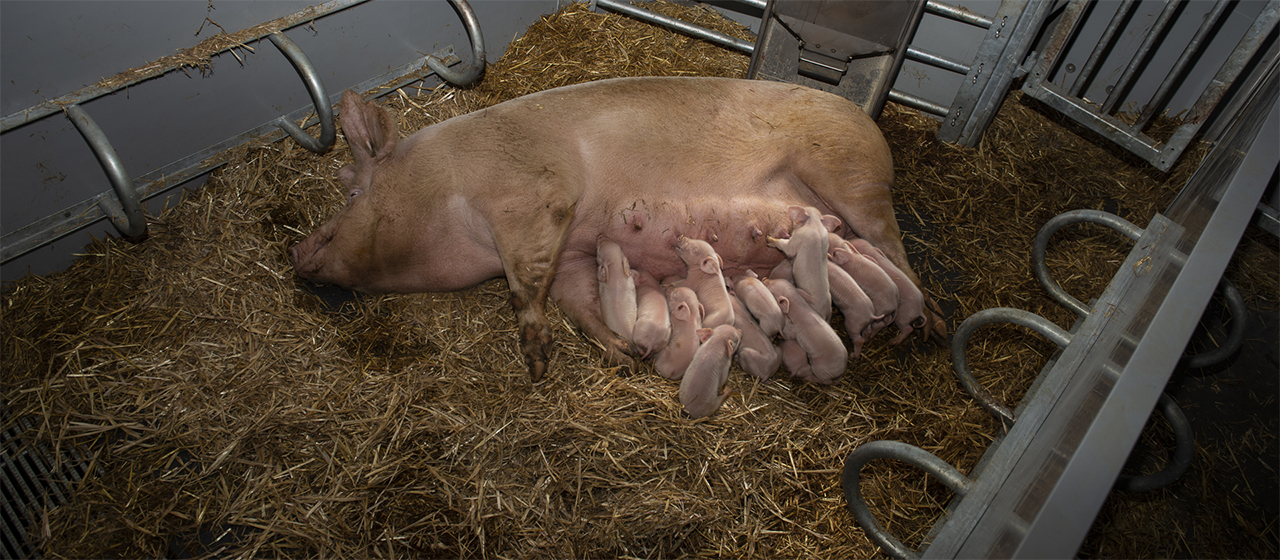
First of all, it is important to decide which farrowing system you choose. Only then can you proceed with your plans. We will not be considering conventional farrowing pens here. The traditional farrowing pen is less future-proof for pig farming in Western Europe and, as things stand, is expected to be phased out gradually. In some countries, free-range farrowing pens are already mandatory, such as in Norway, Sweden and Switzerland. Furthermore, there is already a great deal of experience with traditional farrowing pens, so we have little new information to add on this subject. We are therefore focusing entirely on more future-proof farrowing pens, namely free-range farrowing pens.
With free-range farrowing pens, there are two options. You can choose either a free-range farrowing pen or a free-range farrowing and rearing pen. Of course, this depends on your building options.
Both are good systems that are future-proof, but we believe free-range farrowing pens are the more future-proof of the two. Furthermore, we expect a free-range farrowing pen to deliver a higher return. We will explain why below.
In free-range farrowing pens, you move both the sow and the piglets to other pens after the farrowing period. In free-range farrowing-rearing pens, you only move the sow after the farrowing period, but the piglets remain in the same farrowing pen until they reach 25 kilograms. This means you keep the litter together and do not need to move them. Pigs are creatures of habit and do not like change. Any change causes distress, and distress leads to reduced growth. And this difference in growth can be significant. However, there are further differences between free-range farrowing pens and free-range farrowing-rearing pens. Below, we outline the advantages and disadvantages of free-range farrowing-rearing pens compared to free-range farrowing pens.
- More peace and quiet for the animals. You can keep the litter together in the same farrowing pen (up to 25/30kg) without having to move them to the weaning pen. This provides a great deal of peace and quiet, which benefits the litter and its growth in many ways. This is a recurring benefit.
- Peace of mind for you. Much less labour is required as there is no need to move the piglets to the weaning unit. Furthermore, you do not need to clean the farrowing pens as often, as that stage is, in theory, completely eliminated. This is an ongoing benefit.
- Economic benefit. As there is no longer any need to clean farrowing pens, you save on labour and on the wash water that ends up in the slurry tank. This is an ongoing benefit.
- Investment benefit. You do not need to set up separate piglet pens. This is a one-off benefit.
- More future-proof than free-range farrowing pens, as it improves animal welfare by keeping the litter together in the same pen. This also takes into account future measures to tackle tail-biting. This is a recurring benefit.
What are the main disadvantages of the free-range rearing pen compared to the free-range brooding pen:
- Due to the higher investment required to provide the additional free-range rearing pens, the payback period is approximately 6 years. This is a one-off drawback.
What floor area should I allow for in a free-range farrowing pen or free-range farrowing and rearing pens?
The floor area of farrowing pens is also a topic of debate in every country. Free-range farrowing pens that have already been built are at least 6 m². However, we are hearing that the floor area is increasing rather than decreasing. In Germany, the legal minimum is 6.5 m² per free-range farrowing pen. Furthermore, the number of live-born piglets continues to rise, and sufficient space must be provided for this. We recommend a minimum of 7 m² per free-range farrowing pen to ensure future-proof construction. Furthermore, in Germany, for example, there is a requirement that sows must have sufficient freedom of movement and that piglets must be able to move freely behind the sow. This also affects the floor space required.
What sort of flooring should I choose?
Flooring options are also an interesting topic when it comes to farrowing pens. For example, there is no single specific floor type suitable for free-range farrowing pens; rather, it will need to be a combination of different floor types. After all, in free-range farrowing pens we are dealing with no fewer than three different life stages of the pig: farrowing piglets, sows and weaned piglets. There needs to be a section of slatted flooring, but also a section of solid flooring. In various countries, this is often linked to specific percentages or formulas based on the total floor area. In Germany, for example, the law stipulates that a certain area of solid flooring must be provided beneath the sow and that the floor may only be 7 per cent perforated or feature holes or slats. The law also sets requirements, for example in Germany, regarding the design of farrowing pen floors and the surface areas of the lying and solid-floor sections for piglets. For farrowing piglets, for instance, partially softer floors are preferred. However, these must not be too soft, as this would in turn have disadvantages in terms of hygiene and the durability of the floor. These soft floors with good grip can be achieved quite simply and cost-effectively using, for example, an Ekogrip plastic floor panel with a 2mm rubber top layer. We stock these plastic panels in our range and can manufacture them in any shape and size the customer requires. These durable yet soft panels can also be installed within or on top of the existing floor during renovation work. We also use these panels for the underfloor heating panels which we use, amongst other things, for biggen nests from the Prodromi project. These heating plates can also be supplied made to measure. These heating panels are also frequently used during refurbishment when other heating panels have worn out or no longer heat up properly because they are not oxygen-tight. These are cost-effective solutions that can also be retrofitted when refurbishing existing floors. Practical experience also shows that if you opt for free-range farrowing pens, it is advisable to include a section of concrete flooring within the pen. This ensures sufficient claw wear in the piglets during the rearing period, preventing them from leaving the rearing pens with claws that are too long.
We have close links with flooring manufacturers and suppliers, and we would be happy to put you in touch with them should you wish to find out more.
What type of housing should I choose for free-range farrowing pens?
When designing farrowing pens, a distinction is also made between free-range farrowing pens and free-range farrowing and rearing pens. In free-range farrowing pens, for example, part of the sow pen must be fold-away, whilst in free-range farrowing and rearing pens, the entire sow pen must be fold-away. Before and after farrowing, the sow must have sufficient freedom of movement, and at least one side of the pen must be folded away. However, around the time of farrowing, the sow will still need to be temporarily restrained by folding the pen completely shut.
In the case of free-range farrowing pens, it must in any case be possible to fold up or move the entire pen once the sow has been removed, as the piglets remain there until they reach 25–30 kg and the pen would otherwise be in the way.
There are many systems available on the market, and we hear from sow farmers about the advantages – but certainly also the disadvantages – of existing designs. If you have any questions about this, we can refer you to a farm fit-out specialist who offers the system best suited to your needs, or put you in touch with a fellow sow farmer so you can share experiences.

What is the best feeding and watering system for farrowing pens?
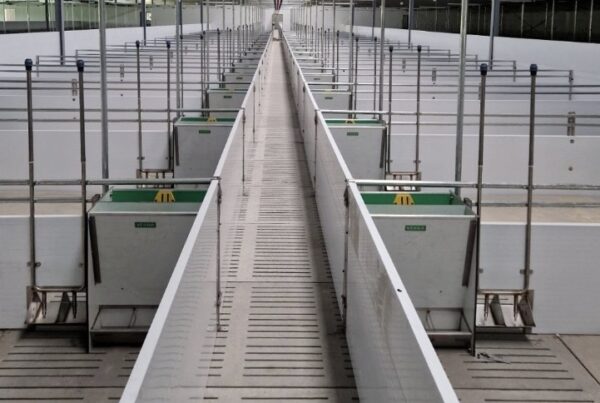
In our view, feeding and drinking are the most important aspects of your free-range farrowing pens. The right feeding trough accounts for at least half the success of your free-range farrowing pen, according to our customer and ambassador, Brummelhuis. The feeding system we recommend for all free-range farrowing pens and free-range farrowing-rearing pens is the KZB maternity pen family feeding trough. Essentially, this is an oversized sow feeder with a closed rear wall, beaded side walls and a lowered feeding trough fitted with a drinking teat for the sow. The flap hangs low, allowing both the sow and her young piglets to operate it, thereby mimicking rooting behaviour. A very simple but robust system.
Throughout her stay in the farrowing pen, the sow feeds from this unique KZB feeder with a lowered feeding trough. Using the flap mechanism, the sow herself dispenses the feed from the KZB feeder’s 36-litre storage hopper. The feeder can be adjusted continuously, allowing the feed rate per flap movement to be set. As the sow eats at floor level, she unconsciously pushes her head against the flap, causing small portions of feed to fall in front of her snout. The sow must therefore feed herself by moving the flap. This mimics natural rooting behaviour, which greatly stimulates feeding compared to a system where feed is simply thrown into a trough for the sow, requiring no further effort on her part.
The drinking nipple fitted to the KZB feeding trough ensures the sow has sufficient water. Here too, we see in practice that piglets start ‘drinking along’ from the sow’s trough at a very early stage. Because the sow drinks much more, the water always remains fresh and is readily consumed by the piglets.
In mid-2021, we received figures from a German pig farmer with conventional farrowing pens and two test farrowing pens fitted with the KZB range of feed troughs. The sows with KZB free-range farrowing pen feed troughs consumed no less than 20 kilograms more sow feed during the farrowing period than those using the sow trough with dosing unit. This is due to various factors, such as fresher feed, the sow having easy access to the trough, her natural rooting behaviour being mimicked, and her playing with the flap, which is followed by a reward. All in all, this significant increase in feed intake greatly boosts the sow’s milk production, which in turn benefits the piglets, who reap the benefits of this head start throughout their lives.
In practice, once the piglets are born, we see that they start nibbling at the sow’s feed as early as around four days after birth, and that the sow teaches the piglets where to find their food. This stimulates saliva production in the piglets at an early stage and ensures that their gut flora adapts to solid food from the outset. At a weight of around 7.5 kilos, we find that, on average, piglets have grown up to 900 grams more than under a traditional system using a sow trough with a dispenser. The piglet benefits from this excellent start throughout its entire life. There is no need to change the feed to achieve these results, and this success is entirely attributable to the KZB feeding trough, which supports mother-offspring behaviour.
Pig farmers with farrowing pens who use the KZB feeding trough report that the piglets reach the target weight one week earlier. Furthermore, an advantage is that, thanks to improved milk production in the sow and the piglets nibbling on the sow’s feed, it is often possible to do without the more expensive prestarter. This results in cost savings. As the piglets are already accustomed to solid feed, they experience virtually no weaning dip after the farrowing period. After all, the transition from milk to solid feed has already been encouraged by the sow from day 4 onwards, meaning there is no sudden change for the piglets.
If the piglets are left in a free-range farrowing pen, they will continue to eat from the same feeding trough. After all, they know where the food comes from and can reach the feed themselves through the flap to take it out of the trough. This produces perfect results.
The sow’s teat is switched off and the piglets must drink from a separate drinker next to the trough. VERBA can also drinking troughs supply for piglets or even attach them to the KZB feeding trough. We also have farrowing pens piglet feeders with a fixed trough or a removable trough, which can be built into the wall and, with their 10-litre feed hopper, can also be used to feed piglets in the farrowing pen at an early stage.
Can I also use a KZB feeding trough in standard farrowing pens?
The answer to that is simple. We are increasingly seeing the KZB farrowing pen feed trough being used in the partial refurbishment of existing farrowing pens, particularly where the trough or water pipe is worn out. By simply changing the feeding method, the sow farmer can immediately benefit from the advantages already described. Thanks to the KZB’s durability (stainless steel), it can easily be incorporated later on when fitting out free-range farrowing pens.
How much does a KZB feeding trough cost?
The KZB replaces a section of fencing and wall – made, for example, of HPL (Trespa) – as well as the sow trough and a separate sow drinker. These additional costs that you would normally incur are virtually comparable to the cost of a KZB feeder. The KZB feeding trough therefore need not be more expensive than a conventional system. Furthermore, the feeding trough pays for itself quickly thanks to the benefits you gain from the piglets’ growth.
How sturdy is a KZB feeding trough?
The KZB feeding trough is not an expensive, high-tech system that is prone to breakdowns. Like all our systems, it is a robust, simple and unique feeding trough that is 100% manufactured in the Netherlands and works exceptionally well for sows and piglets, delivering excellent results. We, and the many users of the KZB feeding trough, sincerely believe that there is no simpler or better feeding system for your farrowing pens than the KZB.
So what are the advantages and disadvantages of the KZB feeding trough compared to a sow feeder with a trough and a separate drinker?
- Significantly higher milk yield from the sow. This is because the sow consumes much more feed due to the way she eats, thanks to the cleverly designed feed trough. This is a recurring benefit.
- A happier and more active sow, as she is able to eat small portions naturally. This is a recurring benefit.
- A healthier sow. As the sow eats more, she emerges from the farrowing pen in better health, which often benefits the development of the embryos in the next litter. This is a recurring benefit.
- No weaning slump. As the piglet starts feeding alongside its mother after just four days, the transition to solid feed goes very smoothly. This is a recurring benefit.
- In farrowing-rearing systems, piglets reach the target weight one week earlier because the transition from milk to solid feed is smoother. This is a recurring benefit.
- More uniform piglets, as they all have enough milk and can help themselves to food from the trough alongside their mother 24/7. This is a recurring benefit.
- It is certainly no more expensive to buy than a separate piglet feeder, sow trough, sow drinker and the finishing work on the pen where the trough is mounted. This is a one-off saving.
- It saves money because far fewer expensive starter feeds are needed for the piglets. This is an ongoing benefit.
- Peace of mind for you. The KZB feed trough is unique and special because of its simplicity. With its beaded edges, the feed trough is extremely robust and does not suffer from the malfunctions to which high-tech systems are more prone. Anyone can operate this system with ease, giving you confidence and peace of mind. This is a benefit you’ll appreciate every day.
Disadvantages of the KZB feeding trough compared to a sow trough with a dispenser and separate drinker:
- The sow cannot lie down under the KZB trough in the same way she could with a higher trough. Depending on the legislation (the space under the trough is not recognised everywhere as allowing the sow freedom of movement), slightly deeper pens may be required in some cases. However, the KZB is only 210 mm deep. This is a one-off drawback.
Verba is able and happy to share its knowledge with you about free-range farrowing pens and free-range farrowing-rearing pens, as well as about feeding and watering in farrowing pens, should you be looking into these options. If you wish, we can also introduce you to the right suppliers who can provide you with excellent support and meet your specific requirements and needs. We work exclusively with reputable livestock housing specialists. We have absolutely no incentive to refer you to a company that does not specialise in free-range farrowing pens or to a company in which we have no confidence. There are farm equipment suppliers who have genuinely specialised in free-range farrowing pens and who manufacture their own systems for this purpose.
As well as expertise, Verba can provide you with information on farrowing pens, including feed troughs for sows and piglets, farrowing feeders, underfloor heating, soft plastic slatted flooring for the enclosed area, piglet pens, piglet nests and drinking troughs. Do you have any questions? Please get in touch! We’d be happy to help. +31 (0)413-474036 info@verba.nl
Jarno Brummelhuis talks about his decision to opt for a free-range rearing pen
Verba farrowing pen products for a variety of different farrowing pens
Jarno Brummelhuis talks about the KZB maternity pen feeding trough