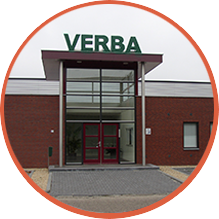
According to Verba, the feed trough plays a central role in how the pig organises its functional areas. Verba has gained this knowledge by keeping production, service and maintenance in-house.
And they are keen to share this knowledge with livestock farmers and research organisations.
Bert Verbakel has spent his whole life amongst the feed troughs. As well as setting up his own pig farm in Sint Oedenrode, Bert began manufacturing steel and Eternit feed troughs under the brand name Verba in 1971. The pig farm, which once housed 1,500 fattening pigs, has since closed down, but Verba products can be found all over the world. “Essentially, we operate in every country that keeps pigs.”
From steel to plastic
“In 1978, with sustainability in mind, we began manufacturing plastic mixing troughs. This made us the first on the market. But the market wasn’t really ready for it yet.”
“Back then, the most popular feed troughs were still made of Eternit, which was a cheaper raw material,” recalls Bert Verbakel. “When the manure legislation was drawn up in the early 1980s, our plastic slurry troughs became more popular. Not so much because of the material, but because of the reduced spillage. With slurry troughs, manure production per pig fell from 2 m³ to 1 m³ per year. At that time, we were growing rapidly and also began to focus on exports.”
These days, nothing has really changed when it comes to feed troughs. “The sale of feed troughs is still a question of price, particularly in Europe. First, the entire barn is built and fitted out, and the feed troughs are installed last. That doesn’t really do justice to
“The usefulness of the feeding troughs,” he says firmly.
Further advice
Bert argues that the role of the feed trough is underestimated. “Feed troughs play a central role in how pigs organise their functional areas. After all, the feeding area is fixed. At open days, I see layouts where I can tell straight away that they won’t be a success. For example, the feeding trough isn’t suited to the pen size, or the solid floor is too far away from the feeding trough. It’s all interlinked,” Verbakel has found.
According to Bert, the pen size, the type of flooring and the breed of pig determine the type of feeding trough that should be installed. “But we or our dealers are generally not asked for that advice, even though we do have that knowledge. Mind you, this doesn’t necessarily mean a feeding trough has to be more expensive, as we offer different price ranges across the various models. As a farmer, you simply make things a lot easier for yourself by installing the right feeding trough correctly from the outset. Then you’ll simply have far fewer problems with manure management.”
In-house service
Verbakel has gained an understanding of the role of the feeding trough in the barn over recent years by carrying out service and maintenance for its customers itself. “We must continue to deliver quality, because a feeding trough needs to last for decades. By carrying out the servicing and maintenance ourselves across Europe, we know how our products function in the barn and have learnt a great deal about the role of the feeding trough in the barn’s layout.”
Verbakel has deliberately outsourced sales to dealers, who are mainly livestock housing specialists. “Feed troughs are hardly sold through the retail trade, as they are not a top priority for livestock farmers. They prefer to buy the entire set-up from a single dealer, so it makes sense for us to sell the feed troughs through those channels,” explains Bert.
Do not outsource production
Verba’s production site has been in the same location in Sint-Oedenrode since 1978, which is remarkable for a company operating in an industry where competition is primarily based on cost price. Bert Verbakel, however, is adamant about outsourcing production abroad. “Producing cheaply
"You achieve this through high efficiency, not through cheaper labour. By automating the production process, you can also compete on cost."
But according to Verbakel, manufacturing abroad is not an option in terms of service either. “In our sector, producing for stock isn’t an option, so customers have to contend with delivery times. That’s often not what they’re looking for. What’s more, transport to Europe isn’t cheap either, so we’ve chosen to keep production within our operating area.”
Verba prefers to keep not only its production but also its research within the region. The company has maintained close ties with VIC Sterksel for many years. Among other things, Verba manufactures the piglet nests based on the Pro Dromi principle. “We are keen to play our part in developments in pig farming, and in return, VIC Sterksel also helps us build brand awareness abroad,” says Bert, explaining the mutual relationship. “At first glance, feed troughs aren’t exactly a component where
"It involves a great deal of innovation. It’s mainly hardware, where, admittedly, there isn’t much scope for further innovation," Bert admits.
Nevertheless, according to the managing director, there is still plenty of scope for development when it comes to the pigs’ feeding area. “Take RFID technology, for example, which allows you to keep the litters intact whilst still feeding the pigs individually,” says Bert enthusiastically. “Sows’ litters are getting bigger and bigger, so the fattening pig units will have to become smaller again. I’m convinced we’ll return to fattening pens holding 12 to 15 pigs, so that litters can stay together. A feeding system that can then feed both boars and gilts from the same litter individually will, however, be essential.”
However, experience has taught Verbakel that innovations are usually about five years ahead of the market. “That’s a recurring pattern with every innovation. It’s only five years after the launch that the market is ready for it. We’re already working on it.”
Another notable trend that Verbakel has observed is the return of what is known as ‘crawling under’. Back in the early 1980s, Verbakel had already introduced ‘under-sling’ systems onto the market, which, possibly in combination with underfloor heating, created a microclimate for the piglets. “In the 1970s and 1980s, tens of thousands of ‘onderkruipen’ and piglet huts were sold every month. That was until the sloping pen layout for sows became popular. Neither huts nor ‘onderkruipen’ fit into that layout, so sales declined. But with the current increase in the number of live-born piglets, you’re seeing a significant rise in interest in piglet shelters. Those piglets need their own climate.”
Company Profile
Verba is the brand name for products manufactured by Verbakel. The company has been based in Sint-Oedenrode (North Brabant) since 1978. Verbakel operates exclusively in the pig farming sector and mainly sells feed troughs for the pig rearing industry. The company is run by Bert Verbakel (68).
Verba generates the vast majority of its turnover from the design, manufacture and supply of feed troughs. Verba now offers a range comprising more than 100 different types of feed troughs. In addition, the company is also known for its under-run pens and plastic piglet nests, which form part of the ProDromi system, amongst other things. The Netherlands is an important market, but 85 per cent of turnover is generated abroad. In principle, Verba operates in every country that rears pigs, extending as far as the Far East, Oceania and South Africa. Within Europe, all products are distributed via dealers. Outside Europe, Verba has its own sales offices. The company employs 26 permanent staff.
Text: Rob van Ginneken